FKINP
Verify a patent maintenance-fee notice by matching its patent details, payment window, entity status, and charge against the USPTO’s official record before authorizing payment.[1][2] Assign someone to pay and someone to confirm USPTO credited the payment.[6][8]
Confirm the patent type and official record
Maintenance fees apply to utility and reissue utility patents based on applications filed on or after December 12, 1980—not design patents, plant patents, or statutory invention registrations.[1]
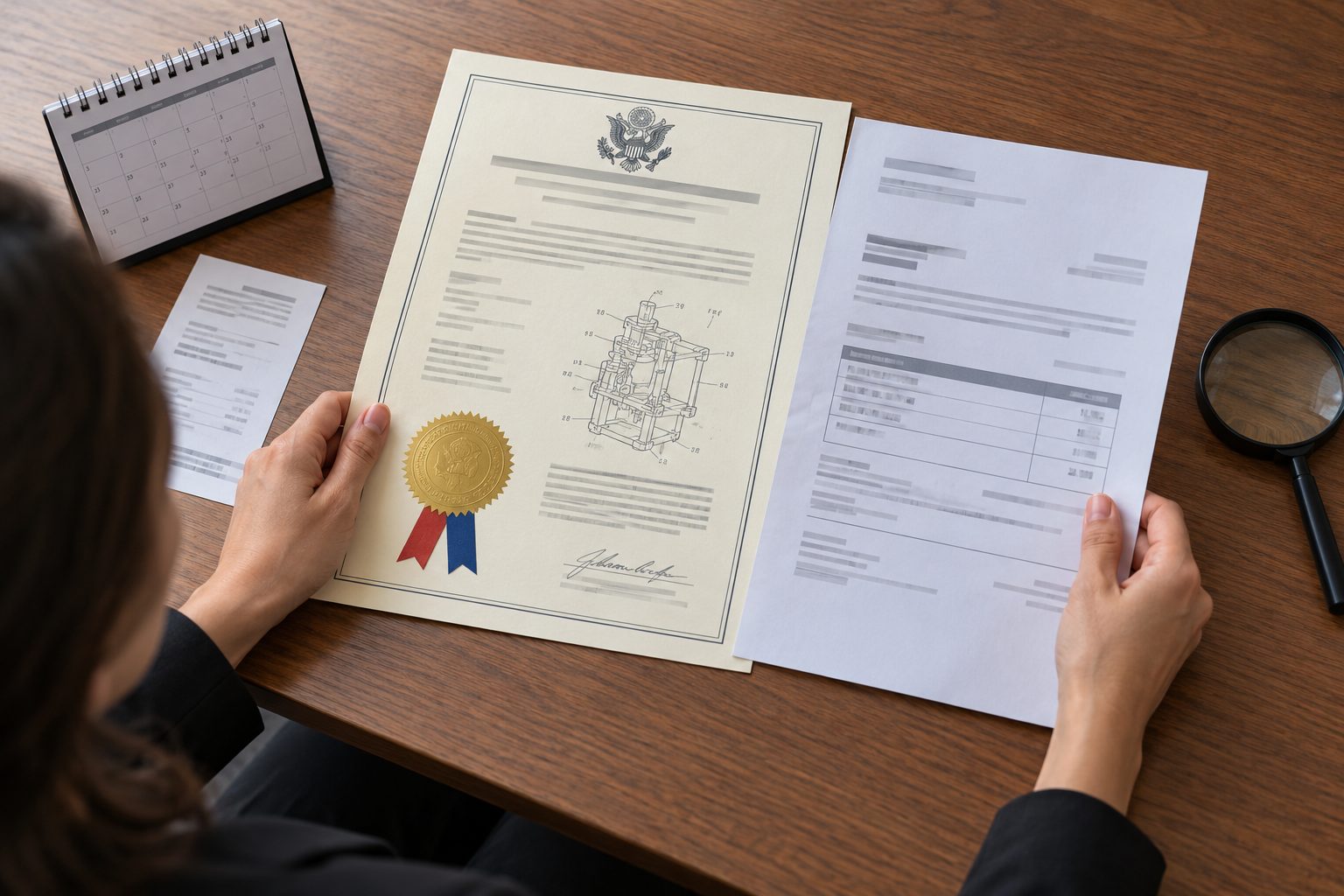
Independently access the USPTO Patent Maintenance Fees Storefront rather than relying on the notice’s payment link.[5] Enter both the patent number and corresponding application number; for a reissue, use the reissue application number.[1] Compare the notice with the Storefront’s patent details, payment-window dates, fees due, current maintenance information, payment history, and recorded entity status.[1]
If the notice and record differ, resolve the discrepancy before treating the notice as payment authority.[1][5] If the deadline is close, check the timing and backup-payment rules below immediately.[1]
Check the payment window
Use the patent-specific dates in the Storefront. Maintenance windows run from the patent’s issue/grant date, not its filing, priority, assignment, or acquisition date.[1][6]
- First payment: surcharge-free at 3–3.5 years; grace period with surcharge at 3.5–4 years after issue.[1]
- Second payment: surcharge-free at 7–7.5 years; grace period with surcharge at 7.5–8 years after issue.[1]
- Third payment: surcharge-free at 11–11.5 years; grace period with surcharge at 11.5–12 years after issue.[1]
Payment cannot be made before the applicable window opens. Each six-month grace period requires the maintenance fee plus a surcharge.[1]
Correct entity status before or with payment
The Storefront calculates online fees using the entity status on file—not the status you intend to claim. Compare the recorded status with the owner’s eligibility. Before paying online, any entity-status change must already be processed; allow 3–5 business days for processing. Only fax or mail payments may include the entity-status request with the payment.[1]
A qualifying small entity may be a person, small business concern, or nonprofit organization and receives a 60% maintenance-fee reduction.[1] Submit the appropriate status document rather than simply choosing a lower payment amount:[1]
- Claiming small-entity status: a written assertion of entitlement.[1]
- Claiming micro-entity status: certification using Form SB/15A or SB/15B.[1]
- Losing small- or micro-entity eligibility: written notification of the loss of eligibility.[1]
Each document may cover only one patent and must be signed by a recognized party under 37 CFR 1.33(b). Recognized signers include qualifying registered practitioners, specified inventors or legal representatives, and certain assignees identified as applicants, subject to those signature rules.[1]
USPTO lists maintenance fees at 3.5, 7.5, and 11.5 years of $2,150/$860/$430, $4,040/$1,616/$808, and $8,280/$3,312/$1,656, respectively (standard/small/micro entity); check the schedule for the surcharge for any six-month grace period. Payment must cover the maintenance fee and any surcharge in the amounts due on the payment date; underpayment does not constitute payment.[1][2]
Protect a last-day payment
Online payment must arrive before midnight Eastern Time on the final day of the applicable payment window or surcharge period—not midnight in your local time zone.[1] If the final day falls on a Saturday, Sunday, or federal holiday, payment may be made on the next day that is none of those.[1]
If the payment system is unavailable
If the system is unavailable on the deadline, USPTO directs users to fax or mail using the applicable procedures under 37 CFR 1.8 or 1.10 to avoid a surcharge or expiration. Follow the mailing and transmission instructions on USPTO’s “Maintain your patent” page.[1]
Do not assume a postmark protects the deadline. Ordinarily, a mailed payment is dated when USPTO receives it, unless the certificate-of-mailing/transmission procedure under 37 CFR 1.8 or the USPS Priority Mail Express procedure under 37 CFR 1.10 applies.[1]
If the grace period has ended
The patent expires if the required fee and surcharge are not received by the grace-period deadline.[3] Payment alone does not automatically restore it: reinstatement requires a petition by a recognized party, the overdue maintenance fee, the applicable petition fee, an unintentional-delay statement, and a signature compliant with 37 CFR 1.33(b).[1] Reinstatement can also be subject to intervening rights protecting certain third-party activities or substantial preparations made after the grace period and before delayed payment was accepted.[3]
Separate official fees from provider charges
Separate a payment request into the official maintenance fee, any official late surcharge, and provider charges. Compare each official item with the USPTO fee schedule amounts listed above for the patent’s entity status; ask the sender to itemize any difference.[1][2][5]
CertOf’s commercial guidance flags private payees, non-USPTO links, urgent deadlines, government-like names or seals, and disclaimers of government affiliation as reasons to investigate—not proof of fraud. Accurate public patent details alone do not make a request official.[5]
Check internal instructions and provider agreements before authorizing payment: was this sender authorized to handle maintenance, and does counsel, an administrator, or another provider already intend to pay?[6][8] Once the obligation and service arrangement are clear, designate one payment owner and a backup.[8]
Assign responsibility and confirm USPTO credited payment
Use a written handoff to the designated payer and backup. Record the following as workflow safeguards, not statutory requirements:[6][8]
- The primary payer, backup, and authorization to proceed.[6][8]
- The window opening, regular deadline, and grace-period deadline.[6]
- The entity-status basis and next review date.[6]
The patentee, or a person or organization acting for the patentee, may pay.[1] USPTO prefers the Patent Maintenance Fees Storefront, which accepts credit/debit cards, USPTO deposit accounts, and electronic funds transfer (EFT). Online payment requires a USPTO.gov account. Do not submit maintenance payments through Patent Center.[1]
A vendor’s acknowledgment of funds is not the closeout evidence: retain the USPTO receipt and payment statement, then independently verify payment posted in the official record.[6][8] Reconcile the patent number and maintenance event against the internal docket and any provider report before closing the task.[8]
Storefront payment-history statements are available for payments made on or after October 1, 2009; an earlier entry marked “Not Available” in the statement column is not, by itself, evidence of nonpayment.[1]
For future notices, a separate fee address may be established solely for maintenance correspondence; otherwise, correspondence goes to the patent’s correspondence address.[1]
References
- Maintain your patent | USPTO (uspto.gov)
- USPTO fee schedule | USPTO (uspto.gov, 2026)
- 35 U.S. Code § 41 – Patent fees; patent and trademark search systems | U.S. Code | US Law | LII / Legal Information Institute (cornell.edu)
- Fake USPTO Invoice? How to Check Trademark and Patent Scam Notices | CertOf™ Translation (certof.com, 2025)
- Check out this article…Patent Maintenance: Fees, Deadlines, and USPTO Payment (upcounsel.com, 2026)
- Patent Maintenance Fees: Deadlines, Expiration, and Revival (tuckerup.com)