FKINP
For a US self-publishing author, commissioning book illustration means buying a consistent visual story, not just a collection of attractive pictures. For a children’s book, start with a settled manuscript and a page plan, then test how an illustrator handles the same characters across a sequence. Agree approvals, revision limits, usage rights and final file requirements before commissioning the complete interior.
Confirm that you are commissioning for the right publishing route
SCBWI distinguishes the routes clearly: it directs self-publishers to its Illustrator Gallery, while explaining that the publishing house’s art director finds the illustrator for a traditionally published book. Check the submission requirements of your intended agent or publisher before paying for a complete illustration commission.[1]
This guide concerns a self-publisher hiring an illustrator for children’s-book interiors. A cover may be a separate deliverable with a different design brief. If you want the same artist to create both, ask for the interior and cover work to be identified separately in the proposal.
Turn the manuscript into a visual production brief
Give candidates the manuscript version you intend them to illustrate, the intended reader, a synopsis, the proposed book format and a target schedule. Reedsy’s commissioning guide recommends stating the illustration requirements, budget and delivery needs when requesting a quote.[2]
Then create a working page map. For each proposed scene, note the text, the visual action, the characters present and anything the picture needs to communicate beyond the words. Identify whether you envisage a small spot illustration, a single-page image or a scene extending across facing pages. Ask the illustrator to review the pacing rather than treating the first map as an unchangeable layout.
For example, a child might hide a letter in one scene and retrieve it later. Include that continuity in the brief, while leaving room for the illustrator to decide how to show it. This is a hypothetical planning example, not a reported production case.
Keep references for setting, character details and desired mood. Explain what you like about them; do not ask the artist to reproduce another illustrator’s images or distinctive characters.
Evaluate sequential work and commission a paid sample
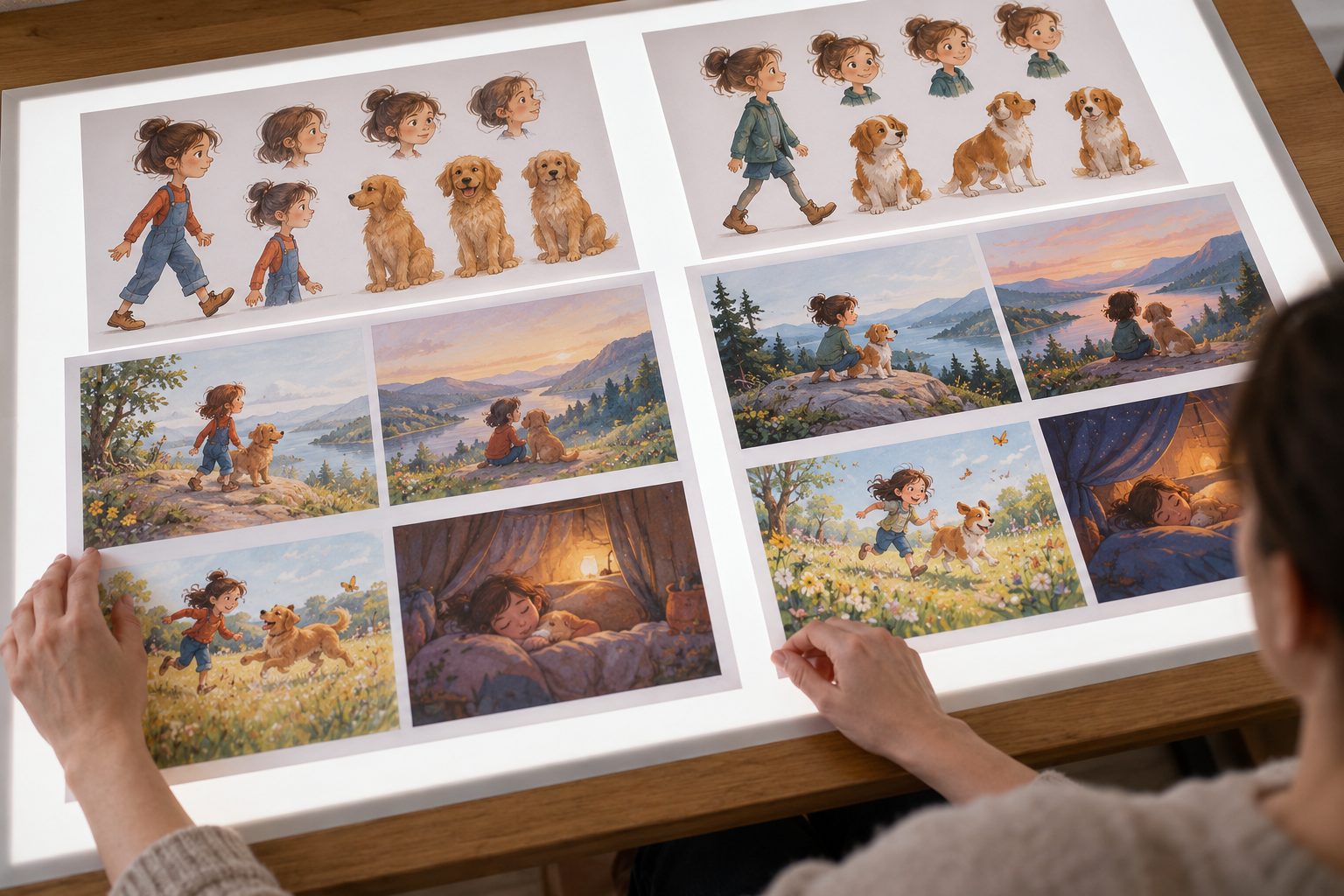
Review relevant picture-book sequences as well as individual portfolio images. Look at whether a character remains recognizable from different angles, expressions and lighting conditions, and whether the visual storytelling suits the intended reader.
Reedsy discusses using a paid art test to assess a prospective collaboration. For your project, propose a limited sample: character studies followed by a representative spread, with its fee and permitted use agreed before work starts.[2]
Use that sample to examine both the art and the collaboration. Can you understand the action without an explanation? Is there room for the text? Does the illustrator explain revisions and respond to the same brief you sent? Give consolidated feedback rather than sending conflicting instructions through several people.
Choose a sample that tests a genuine challenge in the manuscript, such as an emotional change or recurring setting. A decorative scene that avoids the difficult part of the book gives you less evidence for the full commission.
Compare the complete scope and approval stages
For budget context, Reedsy’s guide, updated March 5, 2026, reports a $2,000–$10,000 range for illustrating a full picture book, based on quotes from its marketplace.[2] This is marketplace information, not a US national price survey or an offer for your manuscript.
Ask candidates to quote the same proposed scope. Specify the image types, character-development work, page planning, color treatment, review stages and delivery files. Establish whether lettering, typography, cover art and full-book layout are included or need another designer.
A proposed approval sequence is:
- Character and style approval: Agree the recurring character references and visual direction.
- Whole-book roughs: Review the sequence, text space and page turns before detailed finishing.
- Representative finished spread: Confirm how the agreed style translates into final artwork.
- Remaining final art: Review against the approved roughs and agreed correction process.
- Production handoff: Check the delivery package against the printer’s specifications.
This sequence is an editorial proposal, not a universal industry contract. Ask the illustrator to adapt it and identify the fee for changes requested after an approval. Distinguish correcting a departure from the agreed brief from commissioning a new scene or changing the manuscript.
Agree the rights and the files as separate questions
Payment alone should not be your evidence of what you can do with the illustrations. The US Copyright Office explains that specially commissioned work qualifies as work made for hire only under specified conditions, including the appropriate category and a signed written agreement.[3] Do not assume the label applies to every illustration commission.
Have the agreement state the intended print and ebook uses, promotional use, languages, territories, duration, exclusivity and any credit requirements. Ask separately about changes, future editions, merchandise and the illustrator’s portfolio use. Obtain suitable professional advice if the proposed rights arrangement is unclear.
Also distinguish a right to publish the finished images from delivery of editable source files. Request a file inventory and identify which files you will receive, what software they require, and who will assemble the final book.
Check the print handoff before accepting the commission
If you intend to use Amazon KDP for a paperback, its submission guidance requires single-page interior files rather than two-page spreads and images at a minimum of 300 DPI.[4] An illustration composed across facing pages still needs the correct single-page production output.
KDP also specifies extra dimensions for full-bleed interiors: the manuscript is 0.125 inch wider and 0.25 inch taller than the trim size.[4] For illustration only, an 8-by-10-inch trim would therefore use an 8.125-by-10.25-inch full-bleed page.[4] That calculation concerns the page file, not permission to place important text or faces in the trim area.[4]
Before final acceptance, review the complete interior in the printer’s preview process and inspect a physical proof. Check recurring-character details, sequence, text placement and any agreed corrections. Keep an inventory of final art, layout files and written approvals so a later reprint starts from an identifiable version.
Frequently Asked Questions
- Should I hire an illustrator before approaching a traditional publisher?
- Check the publisher or agent’s submission rules first. SCBWI explains that the publishing house’s art director selects the illustrator in traditional publishing; self-publishers follow a different commissioning route.[1]
- Does a finished illustration spread count as a print-ready book file?
- Not by itself. Confirm who handles layout and production. KDP requires single-page interior files and specifies image-resolution and bleed requirements for its paperback workflow.[4]
References
- SCBWI — Common Questions: Publishing Routes and Finding an Illustrator (scbwi.org)
- Reedsy — How to Find an Illustrator to Bring Your Children’s Book to Life (reedsy.com)
- US Copyright Office — Circular 30: Works Made for Hire, revised August 2024 (copyright.gov)
- Amazon KDP — Paperback Submission Guidelines (amazon.com)