FKINP
FKINP Before advancing a US construction claim, compare delay experts by the records they require, the exact modelling protocol they propose, their forum fit, and the report and testimony stages included in the engagement.
Build the evidence handoff before analysis
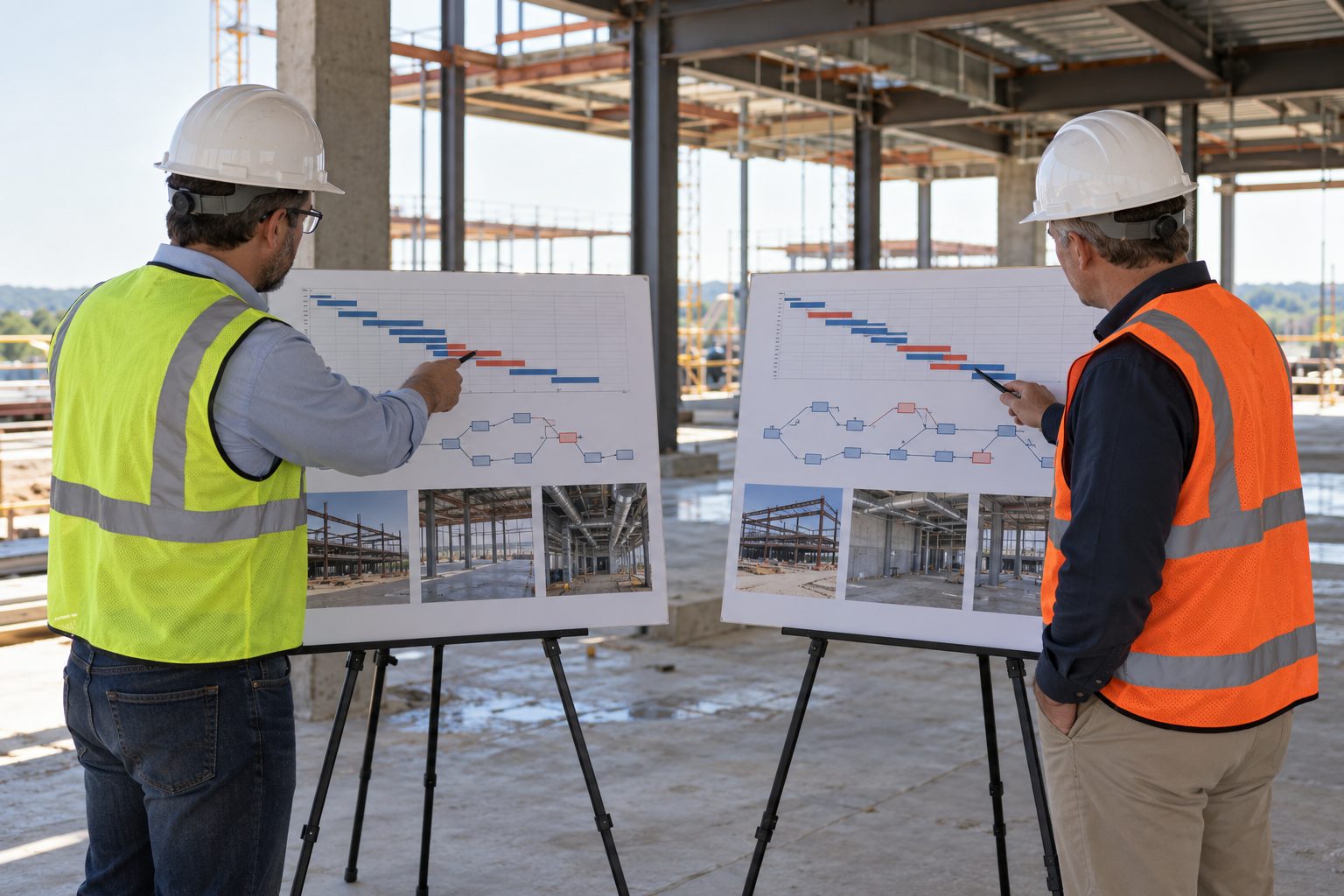
Build one indexed handoff with separate folders for contract and notice material, native schedules, as-built information, an event ledger, site records, cost records and missing items. Treat this structure as a procurement practice, and have counsel set project-specific preservation, privilege, custody and production controls.
- Contract and notices. Start with the governing contract and amendments. Flag notice provisions, schedule-update and extension-of-time requirements, prescribed analysis methods, force-majeure language, no-damages-for-delay clauses, liquidated-damages terms, and instructions identifying how and to whom notice must be delivered.[8][10][11] Constructable’s guidance recommends identifying the event and recognition date, responsible party, affected work and possible time or cost effect, while retaining proof of delivery.[8]
- Native schedules. Provide the approved baseline and every subsequent update in its original file format.[7][8][9][11] Preserve as-built schedule information separately. Long International describes comparing planned, updated and actual performance to investigate causes, effects and changes to critical or near-critical work.[6]
- Event ledger. Give each event a consistent entry. Fields used in a 2024 Fordham Gabelli analysis of NYC DDC delay data include project identifier, delay or gain, category and subcategory, affected phase, narrative, impact in calendar construction days, start date and end date.[5] Link each entry to its supporting files.
- Contemporaneous and cost records. Include change orders, notices, RFIs and submittal logs with response timestamps, meeting minutes, emails, daily reports, site-specific weather records and cost records.[7][8][11] Preserve progress photographs with date, time and location metadata.[8]
- Missing-items register. List absent updates, incomplete date ranges, unavailable native files and other gaps. Identify the expected custodian and any recovery request so the expert can distinguish missing evidence from an event that did not occur.
Screen schedule integrity before choosing a method
SmartPM’s guidance identifies missing relationships, open ends, excessive lags, hard constraints, negative float and out-of-sequence progress as conditions that can distort the critical path and weaken resulting opinions.[9]
Create a defect log by file name and data date. For each issue, record:
- the affected activity or relationship;
- the condition observed;
- whether it appears in the untouched source file; and
- the proposed correction, assumption or sensitivity test.
Require the expert to preserve source files separately from corrected or reconstructed working models and explain each modelling change. This is a procurement transparency test, not a universal US protocol.
Do not use a software score as a substitute for the expert’s explanation. SmartPM reports checking each uploaded schedule against more than 35 quality metrics, but this is a vendor-described capability without an independently validated performance result on the cited page.[9]
Planera and SmartPM describe dynamic analyses as depending on reliable updates, consistent data and sound underlying logic.[7][9] Unresolved defects should appear as stated limitations rather than undisclosed model changes.
Define the modelling protocol, not merely its label
Prospective analysis measures an event against the current schedule while work remains active. Retrospective analysis uses actual records to determine what affected a project that has progressed or finished.[7]
- Time Impact Analysis: Insert a fragnet representing the event into the accepted or current CPM update, then recalculate completion.[7][9]
- Windows analysis: Divide the project into defined periods and evaluate the changing critical path and responsibility within each window.[6][7][9]
- As-planned versus as-built: Compare baseline dates with actual dates. This static comparison may not establish causation reliably when sequences and critical paths changed.[7][9]
- Collapsed as-built: Remove selected events from a reconstructed as-built model to estimate the but-for result. The outcome depends heavily on record quality and modelling judgments.[7][9]
Do not commission work by method name alone. Planera presents Impacted As-Planned and Time Impact Analysis as separate methods, while SmartPM groups those terms under one heading.[7][9] Similar proposal language may therefore describe different modelling exercises.
Require the proposal to state:
- the analysis cutoff date, source schedule, schedule data date, and each event’s start and end dates;
- the activities and relationships to be inserted, changed or removed;
- how actual progress and later logic changes will be treated;
- the boundaries used for any windows analysis; and
- the documents used to assess causation, the concurrency test, responsibility categories and material assumptions requiring documentary support.[6][11]
Match the protocol to the records. Time Impact Analysis needs reliable updates and sound underlying logic, windows analysis needs complete and consistent updates, and collapsed as-built analysis is particularly sensitive to incomplete records and subjective removal decisions.[7][9]
Do not treat a calculated schedule effect as automatic entitlement to time or money. Constructable’s guidance classifies delays as non-excusable, excusable non-compensable or excusable compensable, while warning that concurrency and state-law treatment can change recovery.[8] Counsel should apply the governing contract, law and forum.
Compare named experts by method and forum evidence
Use provider materials to create a shortlist, not as rankings or endorsements.
Long International
- Published approach: Long describes comparisons of planned, updated and as-built schedules, Update Impacted and As-Built But-For windows analyses, concurrency review and allocation of responsibility.[6]
- US and forum evidence: Request evidence of service territory and readiness for the selected US forum.
- Engagement decision: Verify the named expert’s qualifications, availability and ability to implement the proposed protocol.
HPM Consultants
- Published approach: HPM recommends documentary support for each assumption, confirmation of the contract-favored method and pressure-testing against the opposing methodology.[11]
- US and forum evidence: HPM identifies San Diego.[11]
- Engagement decision: Request matter-specific evidence of forum experience and confirm who will perform the analysis and testify.
Accura Consulting
- Published approach: Accura advocates early review of baseline logic, contractual compliance, risks and recordkeeping processes and describes tailored delay and planning support.[10]
- US and forum evidence: Its named expert reports Australian and overseas testimony, and the cited page discusses Australian rather than US cases.[10]
- Engagement decision: Establish relevant US experience and availability before including it on a US shortlist.
The cited provider pages do not state their conflict-search procedures, privilege arrangements, disclosure duties, admissibility standards or forum-specific report rules.[6][10][11] Have counsel verify each issue directly.
No single nationwide US procedure governs delay analysis; the engagement should reflect the governing contract, applicable law and selected court, arbitration panel, board or other forum.[8]
Separate analysis, reports and testimony
Do not compare a preliminary assessment with an engagement that continues through rebuttal and testimony. Use separate scope and pricing lines for:
- preliminary assessment;
- full delay analysis;
- written expert report, exhibits and native model files;
- opposing-report review;
- rebuttal or supplemental reporting;
- counsel or client conferences;
- deposition preparation and attendance;
- hearing or trial preparation and testimony;
- travel; and
- cancellation.
For each line, identify the assigned personnel, work product, assumptions, dependencies, estimated or capped effort, rate basis, expense treatment, due date and approval process for additional work. State whether a preliminary opinion may be used outside the advisory team, converted into a formal report, or supported by the named expert in deposition and at a hearing.
What to confirm with each provider
No comparable dollar price is stated on the cited pages for Long International, Accura Consulting or HPM Consultants.[6][10][11]
- dollar rates, retainers, billing increments, expense rules and caps;
- conflict checks and independence procedures;
- the named expert, supporting personnel and division of work;
- report, rebuttal, deposition and hearing obligations;
- travel and cancellation terms;
- ownership and delivery of models, calculations, schedules, graphics and source indexes; and
- service territory and availability for the relevant forum.
Before authorizing the full analysis, have counsel review the contract and forum requirements, the evidence manifest, the schedule-defect log, the written modelling protocol and every priced or excluded dispute stage.
References
- ANALYZING THE ROOT CAUSES OF CONSTRUCTION DELAYS: A TEXT ANALYTICS APPROACH (nyc.gov, 2024)
- Delay Analysis in Construction: Methods & Claim Examples (long-intl.com)
- Construction Delay Analysis: Methods, Claims & EOT Guide (planera.io)
- Filing and Defending Construction Delay Claims September 2026 – Constructable Blog (constructable.ai)
- CPM Schedule Delay Analysis: Methods and Types (smartpm.com)
- Why Lawyers Should Encourage Early Engagement of Delay Experts — Accura Consulting (accuraconsulting.com)
- Building a Defensible Delay Claim: The Critical Decisions Made Long Before Trial – HPM Consultants (teamhpm.com)